Container Gardening Start to Finish: lesson 2 of 9
How much sun your garden gets
Count the hours of direct sun each spot really gets in the growing season, then give the sunniest spots to the crops that make fruit.
- 4 min read
- Beginner
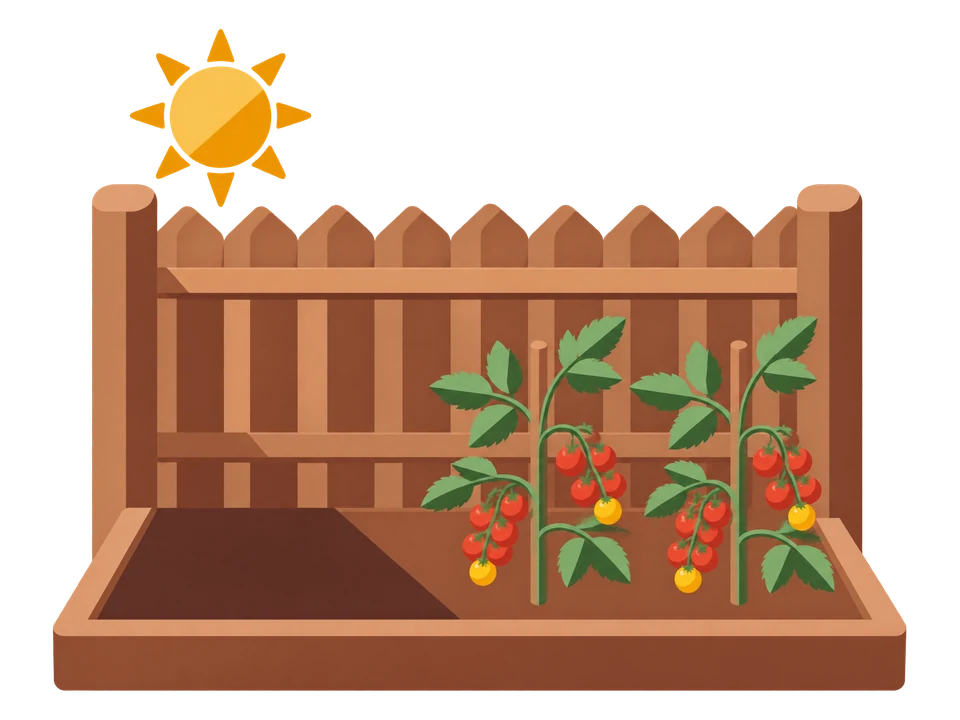
Sun is the one thing you cannot add to a garden from a bag, and it is easy to misjudge. A spot that feels bright from the kitchen window may lose its afternoon to the house next door. An hour of watching is worth more than a year of guessing.
What the words on a plant tag mean
Plant tags measure light in hours of direct sun, the kind that throws a crisp shadow. The Chicago Botanic Garden's definitions are the common ones: full sun is 6 or more hours a day, and part sun is 3 to 6 hours.
Not all hours are equal. Morning sun is gentler than the same hours in the afternoon, which is why greens that wilt by 3 p.m. in an open bed often do well with morning sun and afternoon shade. Bright light that never falls on the leaves, like the glow on a north-facing porch, counts for very little.
Track a spot through one day
You need a clear day in the season you will be growing, and a phone.
- Pick the spots you are thinking of planting: a bed, a corner of the patio, each end of a balcony.
- Look at each one every hour or two from about 8 a.m. to 6 p.m. Note whether it is in direct sun or shade.
- Add up the sunny hours for each spot. A photo from the same place each time makes the pattern easy to see later.
- Repeat in early summer if you did this in spring. Trees leaf out and the sun climbs, so the answer changes.
Hours each kind of crop needs
Sources differ a little, so this table gives the range they agree on and the least each one says a crop can manage.
| Crop | Hours of direct sun | Examples |
|---|---|---|
| Fruiting crops | 6 at the very least; Cornell says 7 to 8, and Virginia Tech says they do better with 8 to 10 | Tomatoes, peppers, squash, cucumbers, beans |
| Root crops | 5 to 6; some sources try them with 4 | Carrots, beets, radishes, onions, potatoes |
| Leafy greens | 3 to 4 at the least; more is fine in cool weather | Lettuce, spinach, chard, kale, arugula |
Fruiting crops
- Hours of direct sun
- 6 at the very least; Cornell says 7 to 8, and Virginia Tech says they do better with 8 to 10
- Examples
- Tomatoes, peppers, squash, cucumbers, beans
Root crops
- Hours of direct sun
- 5 to 6; some sources try them with 4
- Examples
- Carrots, beets, radishes, onions, potatoes
Leafy greens
- Hours of direct sun
- 3 to 4 at the least; more is fine in cool weather
- Examples
- Lettuce, spinach, chard, kale, arugula
The fruiting and root crop ranges are from Cornell, Virginia Tech, NC State, and UC Master Gardeners. The greens are from Cornell and Illinois Extension. Texas A&M also lists leaf lettuce, onions, parsley, and radishes as crops that do well in partial shade.
Fruit takes the most energy to make, so it takes the most light. Leaves are cheaper, which is why a lettuce bed can live where a tomato would sulk. In hot weather, a little shade can even help: UC Master Gardeners note that lettuce and spinach last longer before bolting when they get some.
Why the shadows move
The sun rides higher in early summer and lower in spring and fall, so the same fence casts a short shadow in June and a long one in April or September. A bed that is sunny at midsummer can sit in shade at both ends of the season. Under a deciduous tree it works the other way: plenty of light in early spring, much less once the leaves fill in.
When a plant is asking for more light
Tall, thin, pale stems that lean toward the light, and plants that grow but barely produce, are the classic signs. Texas A&M lists spindly, unproductive plants with insufficient light as the cause. More fertilizer will not fix it.
If your best spot only gets 4 hours, grow greens and herbs there rather than fighting for tomatoes. Cornell and UC both say no vegetable grows in full shade, so a spot with under 3 hours is better for something else. If you garden in containers, the pots can move: a tomato on a wheeled stand can follow the sun across a patio.
Each plant in the plant library lists the direct sun it needs, so once you know your hours you can match crops to spots before you buy anything.
Where this comes from
The numbers and advice here were checked against these pages. Where they disagree, the lesson says so and follows the more careful one.
- chicagobotanic.org /plant-information/sunlight-hours (opens in a new tab)
- cals.cornell.edu /school-integrative-plant-science/school-sections/horticulture-section/outreach-and-extension/pandemic-vegetable-gardening/pandemic-vegetable-gardening-2020-archive/sunlight-key-great-vegetables (opens in a new tab)
- ucanr.edu /site/uc-master-gardeners-placer-county/article/growing-vegetables-less-6-hours-sun (opens in a new tab)
- content.ces.ncsu.edu /mini-gardening (opens in a new tab)
- pubs.ext.vt.edu /426/426-336/426-336.html (opens in a new tab)
- extension.illinois.edu /blogs/flowers-fruits-and-frass/2022-06-24-use-whole-garden-and-grow-salad-shade (opens in a new tab)
- site.extension.uga.edu /paulding/2020/11/landscape-design-part-two-assessing-your-site (opens in a new tab)
- aggie-horticulture.tamu.edu /vegetable/wp-content/uploads/sites/10/2010/10/E-545_vegetable_gardening_containers.pdf (opens in a new tab)