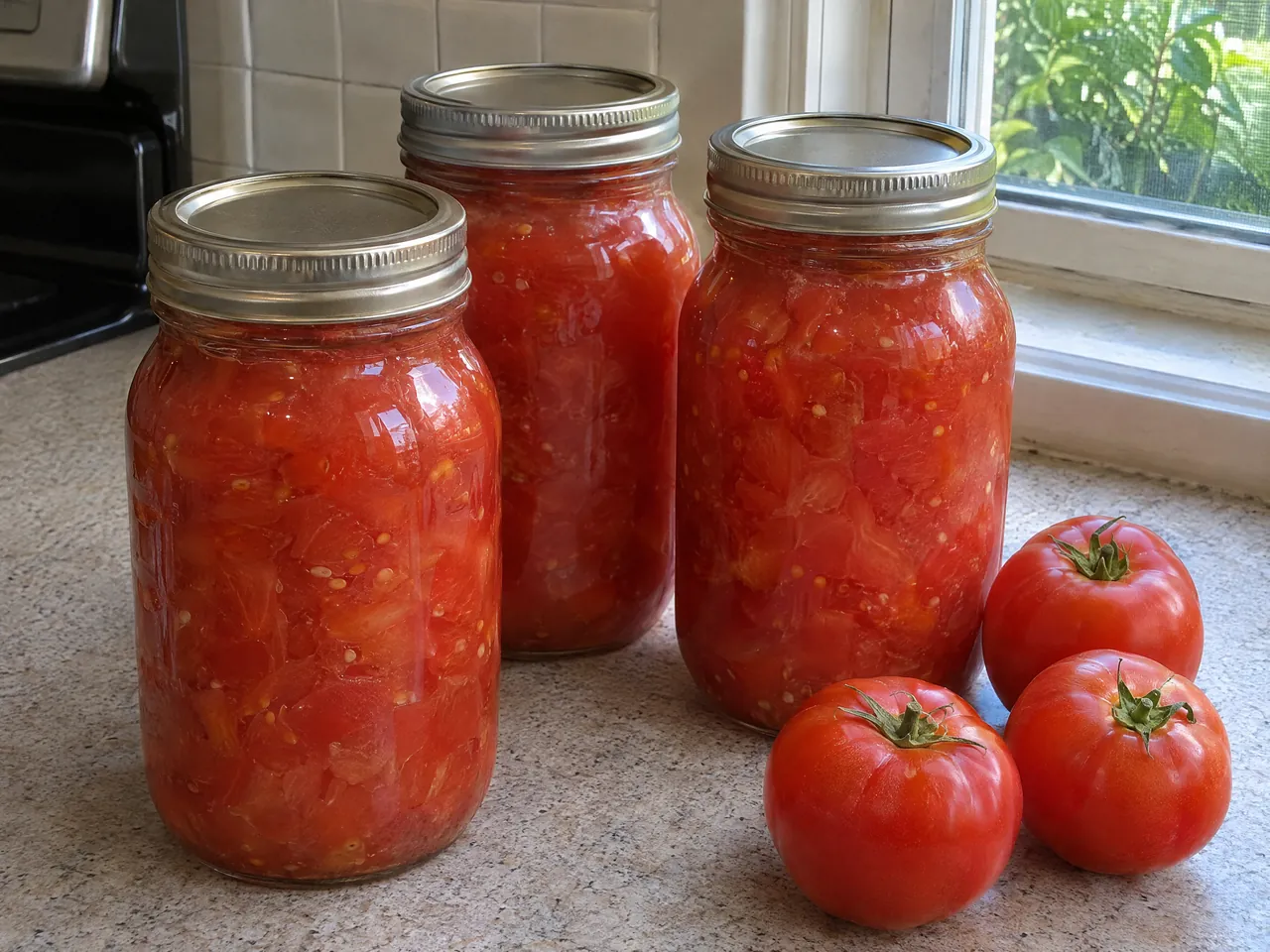
Canned Crushed Tomatoes
Peak season, when you have a bushel of ripe tomatoes: the tested USDA method for jars you can cook with all winter.
- Makes
- 7 quarts or 9 pints
- Prep
- 1 hr
- Cook
- 1 hr 30 min
- Hands-off
- 12 hr
- Total
- 14 hr 30 min
- 3 ingredients, 10 steps
- Uses tomatoes
- Summer
- A project
Before you start
- The lemon juice or citric acid is required in every jar. It makes the tomatoes acidic enough to can safely in a boiling-water canner. Use bottled lemon juice.
- Do not can tomatoes from dead or frost-killed vines.
- Follow the steps and times exactly, and use the time for your altitude.
- Check every jar before you use it. A good lid is curved down in the middle and does not move. Look for streaks of dried food running from the top of the jar, rising bubbles, or an odd color, and when you open it, for a bad smell, spurting liquid, or mold. Never taste food from a jar that has come unsealed or shows any of these.
- The USDA guide says to treat a spoiled jar of tomatoes as if it holds botulism toxin, because there may be little sign of it. If the jar is still sealed, put it in a heavy garbage bag and into the trash. If it is open or leaking, do not just throw it out: it has to be boiled first, and the guide gives the steps ("Identifying and handling spoiled canned food" in Guide 1 of the USDA Complete Guide to Home Canning). Keep the food and its liquid off your skin.
Ingredients
Makes 7 quarts or 9 pints
Tick each one off as you gather it.
Steps
Step 1: Fill the canner halfway with water and heat it to 180°F (82°C) while you work. Wash the jars and keep them hot, and get the lids ready as their maker directs.
Step 2: Wash the tomatoes and dip them in boiling water for 30 to 60 seconds, until the skins split. Move them to cold water, slip off the skins, and cut out the cores.
Step 3: Trim off any bruised or discolored spots and cut the tomatoes into quarters.
Step 4: Heat about a sixth of the quarters quickly in a large pot, crushing them with a wooden spoon as they go in so they give up their juice. Keep stirring so they do not scorch.
Step 5: Once that boils, add the rest of the quarters a few at a time, stirring constantly. They do not need crushing; they soften as they heat. When all are in, boil gently for 5 minutes.
Step 6: Put the lemon juice or citric acid into each hot jar: 2 tablespoons lemon juice (or 1/2 teaspoon citric acid) per quart, 1 tablespoon (or 1/4 teaspoon) per pint. Add 1 teaspoon salt per quart if you like.
Step 7: Fill the jars right away with the hot tomatoes, leaving 1/2 inch (1 cm) of headspace. Slide a flat plastic (not metal) spatula between the food and the side of the jar, turning the jar slowly, to let trapped air out. Top the jar up to 1/2 inch (1 cm) of headspace again if the level dropped. Wipe the rims with a clean damp towel and put on the lids.
Step 8: Set the jars in the canner and process them for the time in the table below for your jar size and altitude.
Step 9: When the time is up, turn off the heat, take the lid off the canner, and wait 5 minutes. Lift the jars out onto a towel, an inch apart, and leave them alone for 12 to 24 hours.
Step 10: Check every seal: press the middle of each lid. If it springs back up, that jar did not seal. Refrigerate it and eat it within a few days, or reprocess it within 24 hours with a new lid and the full time.
Processing time in a boiling-water canner
Leave 1/2 inch (1 cm) of headspace. Keep the water at least 1 inch over the jars (2 inches when the time is over 30 minutes), start the timer once it boils hard, and keep it boiling the whole time; if it stops, bring it back to a boil and start the time over. Use the time for your altitude. Every jar needs its lemon juice or citric acid before it goes in.
| Altitude | Pints | Quarts |
|---|---|---|
| 0 to 1,000 ft | 35 min | 45 min |
| 1,001 to 3,000 ft | 40 min | 50 min |
| 3,001 to 6,000 ft | 45 min | 55 min |
| Above 6,000 ft | 50 min | 60 min |
Good to know
- Four tablespoons of vinegar (5 percent acidity) per quart may replace the lemon juice, though it can change the flavor. A little sugar softens the sour taste if you want it.
- The USDA guide also gives pressure-canner times for this recipe. The lemon juice is still required. See the original if you use a pressure canner.
- A bushel (53 lb) makes 17 to 20 quarts. Use the jars in soups, stews, and casseroles.
Storing: Take off the screw bands, wash and label the sealed jars, and keep them somewhere clean, cool, dark, and dry, ideally 50°F to 70°F (10°C to 21°C) and never above 95°F (35°C). Can only what you will use within a year.
Adapted from “Crushed Tomatoes (with no added liquid),” Complete Guide to Home Canning, Agriculture Information Bulletin No. 539, USDA, revised 2015, National Center for Home Food Preservation. See the original (opens in a new tab) https://nchfp.uga.edu/how/can/how-do-i-can-tomatoes/crushed-tomatoes-with-no-added-liquid/
Grow the roma tomato for this
Each one has a page with its planting calendar: when to start it, when it goes outside, and when it is ready.
Picking and storing
- Roma Tomato
Stays ready to pick for about 45 days.
Store at room temperature stem-side down; refrigeration dulls flavor and softens texture.